Geneva Health Forum 2026 · Poster

Local practitioners use and share HNI more than a year after training

A locally led train-the-trainer model for psychosocial support in South Kivu, DR Congo. This page sets out the methods, findings and limitations of the 2026 follow-up evaluation in full.

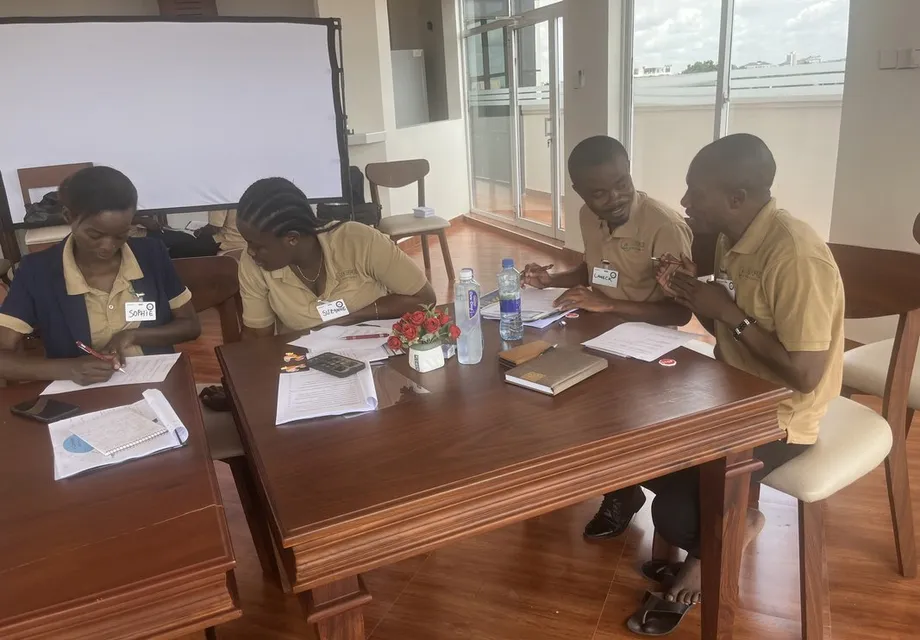
HNI training in South Kivu, DR Congo
South Kivu, DR Congo · July 2025 training

At a glance

What practitioners report 13–14 months later

More than a year after training, all seven surviving practitioners reported using Hypno-Neuro-Imaginative Techniques (HNI) personally and sharing or guiding them with others. Six practised at least weekly; five perceived their general wellbeing as improving “a lot” since using HNI. Continued practice and sharing suggest a pathway for strengthening locally led psychosocial support, with remote supervision and further training still needed.

100%
shared or guided HNI with others (7/7)
86%
personal practice at least weekly (6/7)
71%
general wellbeing improving “a lot” since using HNI (5/7)
7/7
surviving trainees responded

Self-report, n = 7; percentages rounded.

Wellbeing: retrospective perception, not measured change. The 100% describes reported behaviour, not an effectiveness rate.

Authors: S. Lurot¹, A. Python¹, A. J.², R. B.², S. J.², M. Hegyaljai-Python¹

¹ Association Hypnose Humanitaire, Switzerland · ² Hope Association of Africa, DR Congo

Background and objective

Supporting those who support others

In conflict-affected South Kivu, Democratic Republic of Congo, local professionals support people affected by violence while facing insecurity themselves.

Background

A locally led model

AHH and Hope Association of Africa developed a peer-to-peer, train-the-trainer model to make brief stress-regulation practices available within existing local organisations and projects. Local practitioners retain implementation decisions; AHH provides training and remote supervision.

Intervention

What is HNI?

Hypno-Neuro-Imaginative Techniques (HNI) use hypnosis and guided imagery as brief practices for self-regulation. Practitioners adapt HNI to local language, culture and resources — for example with local metaphors, music and dance.

Objective

What the evaluation assessed

Implementation, reported continuation of HNI practice and sharing, and support needs, to inform further development of locally led psychosocial support. Progressive capacity transfer and reduced external dependence are longer-term aims still to be evaluated.

Theory of change

Two routes, local decisions

Local decisions and adaptation connect training and remote support to two routes: personal HNI practice towards staff wellbeing, and peer sharing or guiding towards stronger local psychosocial capacity.

Training + remote support

Local decisions and adaptation

Personal HNI practice

Staff wellbeing

Peer sharing & guiding

Stronger local psychosocial capacity

Dashed links: intended benefits; causal pathways not tested.

Methods

One cohort, two evaluation points

Field implementation in 2025 and a single-cohort observational follow-up in 2026. The earlier workshop with refugee women in Switzerland was a separate pilot and is not pooled with this cohort.

  1. 01

    Training · July 2025

    Hope Association of Africa selected eight local professionals for a four-day training. They embedded HNI in their existing structures and projects, including work with survivors of violence and sexual violence.

  2. 02

    Immediate evaluation · 2025

    Likert scales, checklists and open questions on learning, confidence, personal use and intentions to share; seven retrospective pre–post assessments. Only published aggregate summaries are available, with no matched individual records.

  3. 03

    Follow-up · 19 Aug – 15 Sep 2026

    One trainee died during a field mission. All seven surviving eligible trainees responded (100%), 13–14 months after training: practice, sharing, perceived improvements, barriers, support needs, WHO-5 and the Brief Resilience Scale (BRS).

Percentages are rounded and shown with counts. WHO-5: five-item sum × 4, complete responses only (one incomplete response, no imputation). BRS: mean of six items after reversing items 2, 4 and 6. The general wellbeing item asked about improvement perceived since using HNI; it is separate from the coping item and WHO-5. All participants gave informed consent; AHH conducted an internal ethics review.

Findings from the 2026 follow-up

Use, sharing and perceived benefits

Eight professionals were trained; one died during a field mission. Findings use the seven respondents unless specified otherwise.

Main reported findings, n = 7

  • Sharing HNI or guiding others 100% 7/7 Five a few times per month; two weekly or more.
  • Personal practice at least weekly 86% 6/7 One daily, one several times weekly, four weekly; one rarely.
  • General wellbeing improving “a lot” since using HNI 71% 5/7 Retrospective perception: five “a lot”, two “moderately”.
  • Personal HNI use since training 100% 7/7 Any use since training; frequency asked separately.
  • HNI helped coping “a lot” 71% 5/7 Separate coping item; all seven reported worsening conditions.
  • Further training and guided practice requested 86% 6/7 The same six respondents selected both needs.

Who HNI was shared with

  • Beneficiaries 4/7
  • Survivors of violence 4/7
  • Colleagues 3/7
  • Family 3/7
  • Community groups 2/7
  • Young people 1/7

Categories overlap; no unique beneficiary total is inferred. Six reported positive reactions; one reported hesitant reactions. Sharing does not establish onward teaching competence or beneficiary improvement.

Staff wellbeing and resilience

WHO-5 wellbeing (n = 6)
74/100 (60–84)
Brief Resilience Scale (n = 7)
4.21/5 (3.33–5.00)

Descriptive follow-up scores: with no prospective outcome baseline or locally validated norm, they do not establish improvement, preserved wellbeing or a causal benefit.

Reported barriers

  • Insecurity or difficult travel 7/7
  • Lack of materials 6/7
  • Lack of safe space 4/7

Two respondents requested local-language audio.

“Imagination fosters connection through humour, dreams and shared creativity.”
Anonymous respondent, 2026 survey; translated excerpt. An individual account of perceived usefulness.

From 2025 to 2026

From early uptake to lasting practice

2025: reported gains in learning and confidence; readiness to share. 2026: continued HNI practice and onward sharing; further support requested.

Learning and confidence
2025 · training cohort, n = 8 75% reported knowledge/skills gains; 75% guiding-confidence gains (6/8 for each).
2026 · follow-up, n = 7 These items were not repeated.
Personal practice
2025 · training cohort, n = 8 Early personal uptake reported; historical percentage omitted pending verification.
2026 · follow-up, n = 7 100% used HNI since training (7/7); 86% practised at least weekly (6/7).
Sharing
2025 · training cohort, n = 8 75% planned local-group engagement and requested localised tools.
2026 · follow-up, n = 7 100% shared or guided others (7/7), across overlapping recipient categories.
Continuing support
2025 · training cohort, n = 8 Demand for localised tools.
2026 · follow-up, n = 7 86% requested further training and guided practice (6/7); two, local-language audio.

Different questions and denominators prevent a matched change estimate, and no growth rate is calculated between the 2025 intention and the sharing reported in 2026.

Discussion

What this suggests — and what it does not show

Discussion

A practical pathway

Continued reported HNI practice and sharing, alongside perceived wellbeing benefits, suggest a practical pathway for strengthening locally led psychosocial support. Practitioners adapt HNI within existing activities, retain implementation decisions and receive remote supervision.

Local capacity

A foundation to consolidate

Reported sharing with colleagues, beneficiaries and survivors of violence, together with local decision-making, provides a foundation for capacity development. Requests for further training and guided practice identify priorities for consolidating local delivery.

Limitations

Read with caution

Small sample, self-report and no prospective outcome baseline or comparator limit causal interpretation and generalisation. Beneficiary outcomes and onward teaching competence were not independently assessed.

Next steps

Evaluate prospectively

Extend locally led training and follow-up with guided practice and adapted resources. Prospectively assess staff wellbeing, beneficiary outcomes and teaching competence; track external support to evaluate progressive capacity transfer; add comparison studies where feasible.

Global mental health

Implications

Embedding HNI within local organisations may extend psychosocial support through staff self-regulation and peer sharing. This experience supports further development and evaluation of the approach in conflict-affected settings.

Further reading

Chapter · Routledge, 2026

The Routledge International Handbook of Trauma-Responsive Peacebuilding

Python A, Ribaux C, Hegyaljai Python M — Hypno-Neuro-Imagination Techniques for Promoting Mental Health in Humanitarian-Peacebuilding Contexts

The chapter describes the HNI approach in humanitarian and peacebuilding contexts.

Further reading on the approach; it is not validation of this cohort's outcomes.

References and sources

  1. AHH and Hope Association of Africa. Programme abstract prepared for Geneva Health Forum 2026, with subsequent programme clarifications. Internal source.
  2. Lurot S, Python A, Hegyaljai-Python M. Hypno-Neuro-Imaginative Techniques (HNI): A neuroscience-based Mental Health Tool for Vulnerable and High-Stress Populations. Swiss Public Health Congress supporting report, 11 September 2025 (Congo cohort, pp. 3–4).
  3. AHH and Hope Association of Africa. South Kivu staff follow-up survey, 19 August – 15 September 2026. Seven responses. Internal dataset.
  4. World Health Organization. The World Health Organization-Five Well-Being Index (WHO-5). 2024. who.int
  5. Smith BW, et al. The brief resilience scale: assessing the ability to bounce back. International Journal of Behavioral Medicine. 2008;15(3):194–200. doi.org
  6. Skivington K, et al. A new framework for developing and evaluating complex interventions: update of Medical Research Council guidance. BMJ. 2021;374:n2061. doi.org
  7. Geneva Health Forum. Themes for the 2026 conference — Rethinking Cooperation in Global Health. conference2026.genevahealthforum.com

Strengthen locally led support together

Local partners, humanitarian organisations, researchers or funders: let's develop the next phase of support and evaluation with our local partners.